
No products in the cart.

Sale!
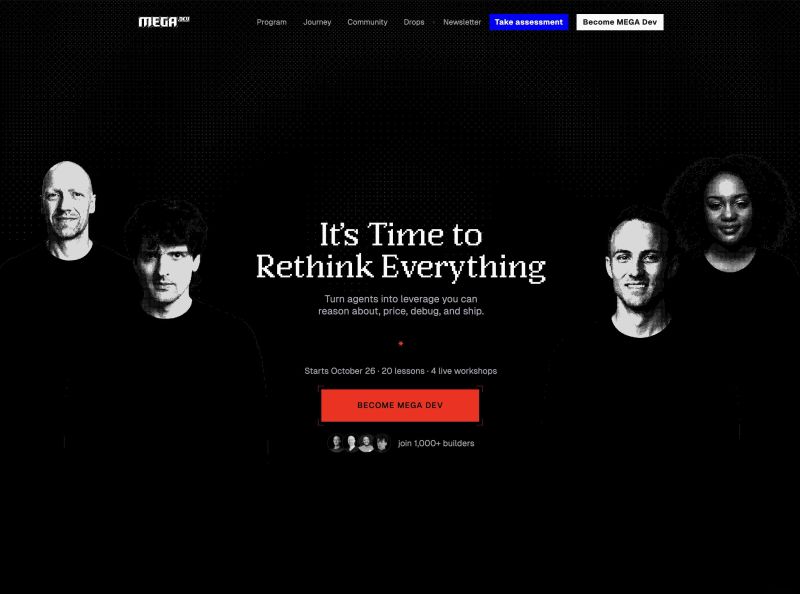
[Group Buy] Mega Dev. It’s Time to Rethink Everything
Original price was: $1,200.00.$49.00Current price is: $49.00.
In the rapidly maturing landscape of software development and cloud systems architecture, artificial intelligence has expanded far beyond simple conversational chatbots, toy scripts, and basic autocompletion tools. Contemporary engineering organizations frequently encounter a substantial operational bottleneck: while generative assistants can draft code snippets rapidly, integrating these autonomous capabilities into dependable, production-grade applications remains a complex software challenge. The premier four-week AI engineering course program delivered by MEGA provides an authoritative, systemized curriculum designed to transform software practitioners into high-leverage technical leaders. By shifting developer focus away from speculative prompting tricks and grounding it firmly in rigorous systems engineering, this immersive training enables technical professionals to reason about, price, evaluate, debug, and deploy autonomous systems that perform reliably in demanding commercial production environments.
At the foundation of the learning journey is a comprehensive exploration of generative mechanics, model limitations, and foundational model steering across diverse cloud providers. Rather than treating machine learning interfaces as unpredictable black boxes or relying on blind trial-and-error experimentation, participants examine model boundaries, inference mechanics, and token processing dynamics in structured architectural detail. The curriculum places exceptional emphasis on context engineering for AI agents, guiding engineers through the systematic curation of system settings, dynamic memory pipelines, custom toolkits, and structured technical specifications. By mastering these environmental parameters, students gain the technical proficiency necessary to prevent catastrophic context drift, mitigate hallucinations, and reliably align model outputs with intricate enterprise architectural requirements.
Moving into applied implementation, this specialized AI agent development course breaks down the exact architectural primitives necessary to build autonomous software entities capable of real-world action. Enrollees discover how to build AI agents equipped with dynamic tool execution, structured memory buffers, and custom skill libraries through hands-on repository projects. The coursework demystifies complex AI agent architecture, establishing clear design patterns for sandboxed tool execution, permissions governance, model context protocols, and continuous observability. Through rigorous validation frameworks, automated evaluations, and defensive guardrails, developers ensure that their autonomous actors adhere strictly to operational safety boundaries, recover from runtime exceptions gracefully, and execute complex multi-step objectives with complete resilience.
Beyond single-agent implementations, this comprehensive agentic AI course immerses learners in sophisticated distributed systems, agent-to-agent communication protocols, and collaborative multi-agent patterns. Participants explore AI agent orchestration strategies that coordinate specialized digital workers across complex asynchronous workflows, establishing reliable delegation protocols, shared memory channels, discovery mechanisms, and automated handoffs. In addition, the program explores advanced AI coding workflows, demonstrating how to integrate autonomous coding agents into daily developer routines to tackle unit testing, codebase refactoring, pull request reviews, and continuous integration pipelines without sacrificing code quality, team velocity, or software craftsmanship.
The curriculum further addresses the critical transition from functional code prototypes to customer-facing software products that deliver genuine commercial value. Students explore product engineering frameworks that translate high-level commercial intent into structured agent specifications, automated verification checks, quality gates, and system difference analyses. Through real-world project builds, developers discover how to construct self-healing pipelines and adaptive feedback mechanisms that allow deployed systems to observe telemetry signals, learn from post-release execution errors, synthesize operational feedback, and self-optimize over time without requiring continuous human supervision.
Ultimately, this intensive AI agents course for developers bridges the divide between experimental generative technology and enterprise-grade software delivery. Enrollees benefit from a rich educational ecosystem comprising twenty detailed technical lessons, four interactive live workshops, real-world source repositories, and a collaborative professional developer community. By completing practical challenges and collecting twelve specialized skill cards, learners earn an industry-recognized certificate of skill that verifies their ability to ship resilient, autonomous systems. Graduates emerge fully equipped to command technical authority, drive transformative business value, and build the future of software development.
What you’ll learn of this course:
- Master foundational generative model mechanics, inference parameters, and token processing constraints.
- Design robust context engineering architectures to control model steering and eliminate hallucinations.
- Build specialized autonomous agents featuring custom tools, structured memory buffers, and sandboxed loops.
- Orchestrate multi-agent collaborative networks using structured delegation protocols and shared context planes.
- Streamline daily engineering routines by deploying automated AI coding workflows across repositories.
- Implement automated evaluation suites, guardrails, and quality gates to verify product outcomes.
- Construct autonomous, self-healing software pipelines that observe runtime signals and optimize over time.
Requirements before start this course:
- Intermediate-to-advanced proficiency in modern programming languages such as TypeScript, JavaScript, or Python.
- Practical experience working with terminal environments, command-line developer tools, and Git repositories.
- Prior familiarity with AI-assisted developer tools such as Cursor, Claude Code, or modern coding assistants.
- Access to a desktop computer with a reliable internet connection to run code repositories and stream workshops.
Who this course is for:
- Mid-level and senior software developers wanting to transition from casual AI prompting into systems engineering.
- Full-stack engineers, frontend developers, and backend architects looking to build production-grade agentic systems.
- Engineering managers, technical team leads, and software architects designing autonomous agent workflows.
- Product engineers seeking reliable frameworks to translate commercial requirements into verifiable AI deliverables.
- Software professionals eager to earn an elite skill certificate and build resilient, automated engineering pipelines.
What about the author:
The instructional architect behind this groundbreaking program is acclaimed software educator, technologist, and systems developer Adam Gospodarczyk. Bringing extensive experience in applied artificial intelligence and technical curriculum design, Adam Gospodarczyk has spent years training thousands of software engineers in the practical deployment of machine learning workflows. As the lead architect of the MEGA initiative, he designed the overarching curriculum framework, seamlessly connecting foundational generative mechanics, specialized agentic primitives, and production product delivery into an interconnected learning experience that equips engineers to build reliable digital systems.
Co-teaching alongside him is an elite faculty of globally recognized engineering leaders and educators. Veteran developer advocate, international keynote speaker, and technical educator Angie Jones brings world-class expertise in test automation, software architecture, and systems reliability to the agent development modules, guiding students through agent loops, tool design, and automated evals. Renowned software instructor Kent C. Dodds, celebrated internationally for teaching architectural rigor and high-standard testing methodologies to developers worldwide, leads the product engineering curriculum, focusing on intent translation, verification gates, and quality software delivery.
The instructional team is further strengthened by full-stack pioneer and open-source innovator Theo Browne, whose deep technical expertise in systems architecture, developer tools, and generative AI mechanics anchors the foundational model steering coursework. Completing the faculty is prolific developer instructor John Lindquist, co-founder of Egghead.io, who guides the advanced curriculum on autonomous system takeoff, portable control planes, multi-agent coordination, and self-improving software pipelines that operate reliably while developers sleep.
Together, Adam Gospodarczyk, Angie Jones, Kent C. Dodds, Theo Browne, and John Lindquist combine decades of industry leadership, open-source innovation, and technical pedagogy to deliver an unmatched educational standard. Their teaching philosophy firmly rejects superficial prompting shortcuts, passive tutorials, and marketing hype, focusing exclusively on hands-on code development, architectural patterns, and production resilience. Through live technical workshops, real-world repository challenges, and direct community mentorship, they equip developers with institutional-grade knowledge directly derived from high-scale engineering environments.
Today, Adam Gospodarczyk and the MEGA faculty remain actively engaged on the front lines of artificial intelligence research and developer tooling, continually testing emerging model capabilities and publishing open-source resources for the global developer ecosystem and software engineering community. Their ongoing involvement in enterprise software development guarantees that all course architectures, repository templates, and evaluation standards reflect modern production practices. Through this dedicated collaboration, the instructors empower software engineers worldwide to master agentic systems, eliminate workflow bottlenecks, and build durable careers at the cutting edge of digital innovation.
Sales Page: _https://mega.dev/
Delivery Time: 12 – 24hrs after purchased.
Be the first to review “[Group Buy] Mega Dev. It’s Time to Rethink Everything”
Related products
Sale!

Original price was: $1,497.00.$15.99Current price is: $15.99.
Sale!

Original price was: $1,497.00.$69.60Current price is: $69.60.
Sale!

Other Courses
Original price was: $1,997.00.$44.50Current price is: $44.50.
Sale!

Original price was: $70.00.$25.50Current price is: $25.50.

Other Courses
$25.00

$4.95
Sale!

Original price was: $499.00.$49.00Current price is: $49.00.
Sale!

Other Courses
Original price was: $697.00.$69.70Current price is: $69.70.
Reviews
There are no reviews yet.